
Prepare products and assets for a transparent, circular economy
Digital Product Passport & Sustainability
The European Digital Product Passport is changing how product and asset information needs to be structured, shared and governed. Organizations will need reliable lifecycle data about materials, components, origin, usage, repairability, documentation, environmental impact and end-of-life options.
Purple Unity helps companies create the digital foundation for product passports and sustainability reporting by connecting product, asset, document, service, supply chain and lifecycle data into one structured and accessible context.
This enables organizations to prepare for upcoming regulation, improve transparency and unlock circular business models such as reuse, repair, refurbishment, sharing and remarketing.



Sustainability ambitions depend on lifecycle data that is often fragmented
The challenge
Product and asset data is usually spread across many systems, suppliers, documents and departments. Technical specifications may live in PLM or ERP, sustainability data in reports, certificates in document systems, service history in support tools and ownership or usage data in separate portals.
For a Digital Product Passport, this fragmented information needs to become reliable, traceable and accessible. Organizations need to know what data exists, where it comes from, who owns it, how it changes over time and which stakeholders are allowed to access it.
Without a connected lifecycle data foundation, product passport initiatives risk becoming manual, isolated compliance projects instead of a scalable capability for sustainability and circular value creation.


What Purple Unity enables
One connected lifecycle context for product passport and sustainability data
Purple Unity connects product, asset, component, document, company, contact, service and lifecycle information into one structured environment. Existing ERP, PLM, PIM, CRM, service, document and sustainability systems can remain in place, while Purple Unity creates the digital layer that makes their information usable in context.
This creates a scalable foundation for Digital Product Passport initiatives, sustainability reporting, circular workflows and stakeholder transparency.
Connect product, asset and component data
Relate products, assets, components, materials, configurations, documents and lifecycle events in one connected data model.
Build a product passport data foundation
Structure the information needed for Digital Product Passports, such as origin, material composition, documentation, repairability, service history, ownership context and end-of-life information.
Manage sustainability documents and evidence
Link certificates, declarations, manuals, environmental documentation, inspection reports, media and compliance evidence directly to the right product, asset or component.
Support circular lifecycle workflows
Enable workflows for repair, reuse, refurbishment, sharing, return, resale, recycling and responsible end-of-life handling.
Share information with the right stakeholders
Give customers, partners, suppliers, service teams, auditors or buyers controlled access to relevant passport and sustainability information.
Connect systems and automate data exchange
Integrate with ERP, PLM, PIM, CRM, document management, service, IoT, sustainability and reporting systems through APIs and events.
What Digital Product Passport & Sustainability context makes possible
When product, asset, component, document and lifecycle data are connected, organizations can move beyond compliance and create a foundation for transparency, circularity and new business value.
Better preparation for Digital Product Passport requirements
Organizations can start structuring and governing the product and lifecycle data needed for upcoming EU product passport obligations. The ESPR creates the framework for Digital Product Passports, with detailed requirements to be defined per product group through delegated acts.
Stronger sustainability reporting
Product, asset, service, repair, reuse and end-of-life data can be connected to support internal reporting, external communication and compliance processes.
Easier repair, reuse and refurbishment
When technical documentation, service history, spare parts, condition data and ownership context are connected, it becomes easier to extend product and asset lifecycles.
Better circular business models
Organizations can use lifecycle data to support sharing, return, resale, refurbishment, recycling and remarketing flows.
More reliable compliance evidence
Certificates, declarations, inspection reports, manuals and sustainability evidence can be linked directly to the product or asset they belong to.
Improved collaboration across the value chain
Suppliers, manufacturers, service partners, customers, auditors and resale partners can contribute to and use the same governed lifecycle context.
AI-ready sustainability operations
Structured product passport and sustainability data can be made available to AI agents for search, data enrichment, documentation support, workflow guidance and decision support.
Purple Unity products help asset-driven organizations connect assets, data, people and processes across the full asset lifecycle.

Asset Data Manager

Company & Contacts Manager

Contract Manager

Asset Sharing Engine

Service & Support Engine


Auction Engine
Start with the workshop playbook
Use the playbook to prepare your exploration: map your asset lifecycle, stakeholders, systems, collaboration challenges and opportunities for applied AI.

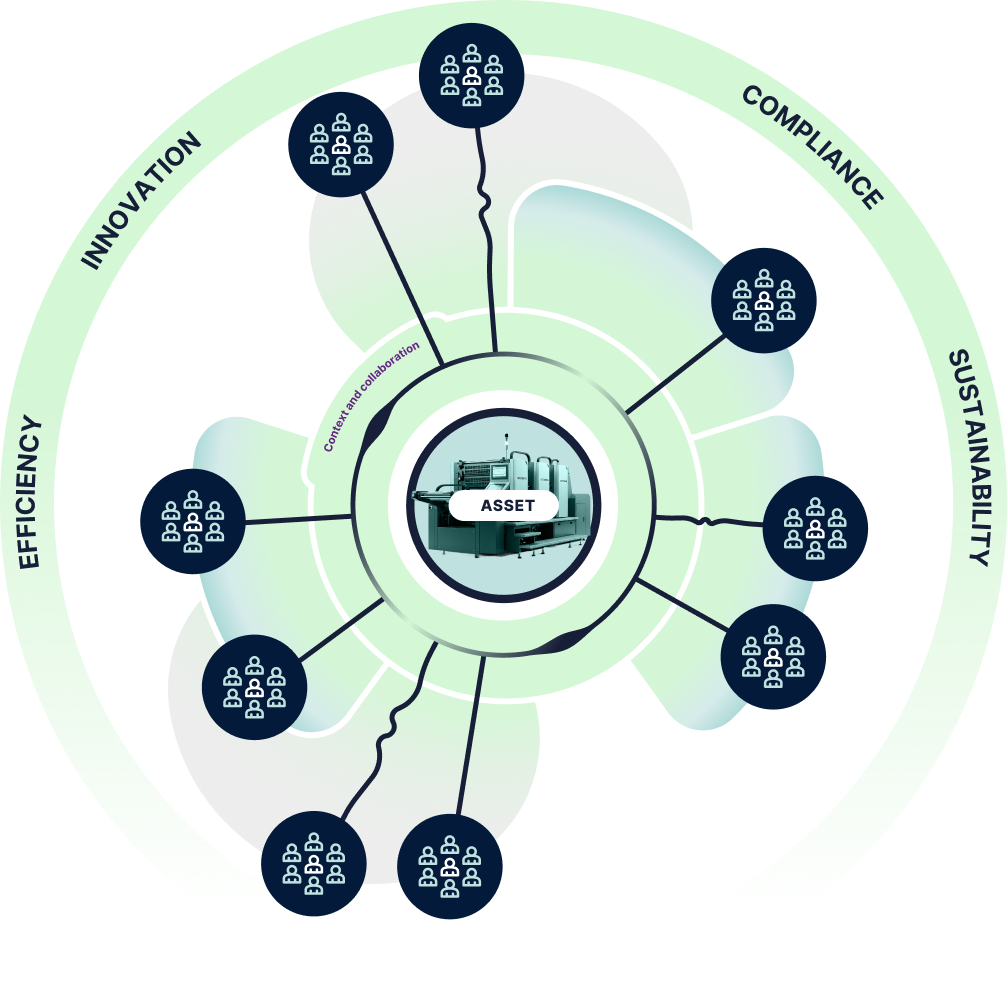
The foundation behind every capability
Purple Unity is built on a shared foundation that connects assets, information, people and systems across the asset lifecycle. This foundation helps organizations structure asset information, collaborate in context, control access, integrate with existing systems and create digital experiences for every stakeholder involved.


