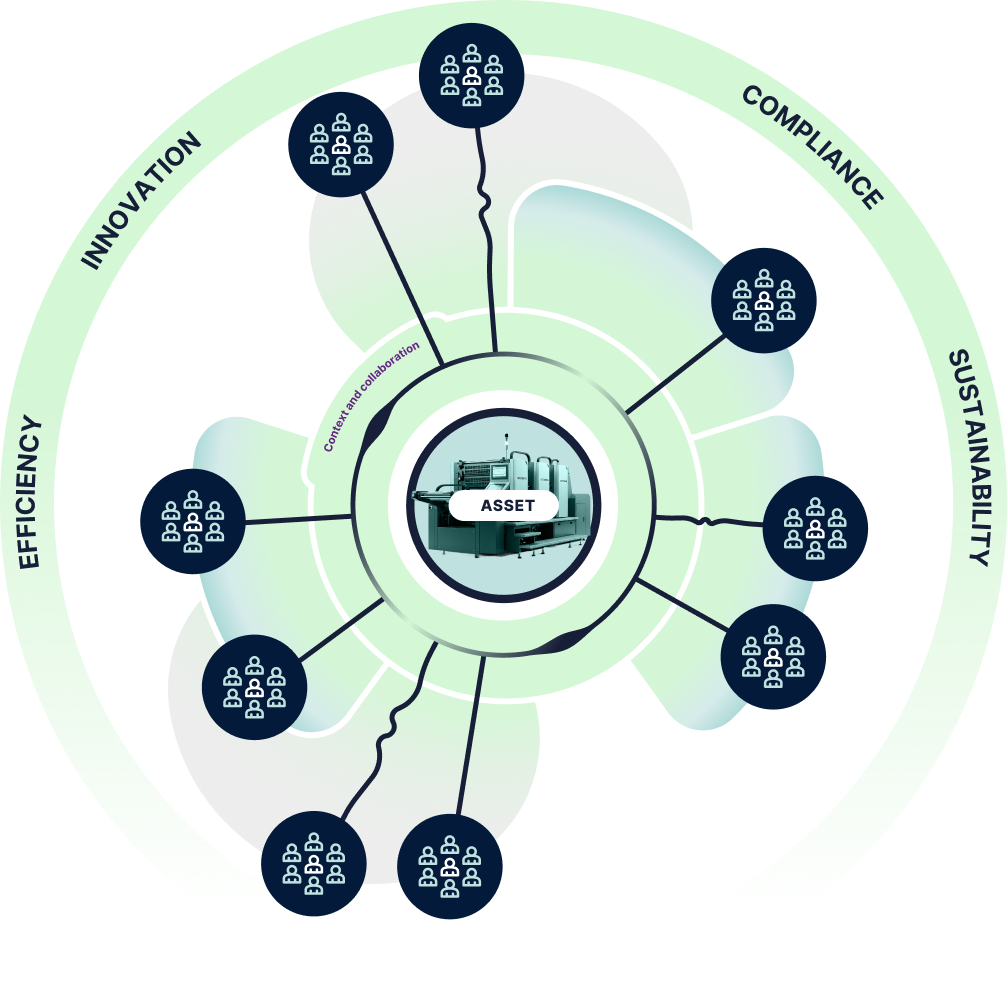
AI agents powered by trusted asset context
AI for Asset Work
AI becomes valuable when it can work with the right context. Purple Unity helps organizations use AI agents on top of structured asset data, documents, relationships, workflows and lifecycle events.
Instead of experimenting with isolated AI tools, Purple Unity creates a governed foundation where AI can search, explain, support, enrich and assist across asset-related processes, safely connected to your systems, portals and business rules.


AI is only as useful as the context it can access
The challenge
Many organizations want to use AI to improve service, operations, sales and lifecycle management. But asset information is often fragmented across ERP, PLM, CRM, service systems, documents, spreadsheets and portals.
Without reliable and governed context, AI agents cannot give accurate answers, support workflows or take meaningful action. They risk becoming disconnected assistants that depend on incomplete data, unclear permissions and manual copy-paste work.
To make AI useful in real asset operations, organizations need more than a model. They need structured asset context, controlled access, clear data relationships and integration with the systems where work actually happens.

What Purple Unity enables
A governed AI layer for asset-related work
Purple Unity connects asset data, documents, media, companies, contacts, contracts, service cases, auctions, sharing workflows and lifecycle events into one structured context. This context can be made available to AI agents through governed APIs and MCP.
That means AI can work with reliable information, respect access rules and support real workflows across customer portals, partner environments, service teams and internal operations.
Give AI trusted asset context
Connect AI agents to structured asset data, documents, lifecycle events, relationships and workflow history.
Enable natural language search
Let users ask questions across assets, documents, service cases, contracts, companies and lifecycle information.
Support service and operational teams
Use AI to help teams find answers, summarize asset history, suggest next steps and support case handling.
Enrich and structure asset information
Assist users in extracting, validating and structuring information from documents, media, reports or external sources.
Power AI-enabled portals
Bring AI assistance into customer portals, partner environments and internal workspaces where users already interact with assets.
What AI for asset work makes possible
When AI is connected to trusted asset context, it becomes a practical business capability rather than a separate experiment.
Faster answers for teams and customers
Users can find asset information, documents, service history and lifecycle context without searching across systems or folders.
More efficient service operations
Support and service teams can use AI to summarize cases, retrieve relevant documentation and suggest next actions.
Better use of existing knowledge
Manuals, reports, certificates, inspection documents, media and lifecycle data become easier to access and apply in daily work.
Higher data quality
AI can help identify missing information, enrich asset profiles, classify documents and support data validation.
Smarter customer and partner portals
Customers and partners can interact with asset information through guided search, contextual answers and AI-assisted workflows.
Safer AI adoption
AI agents work from governed data, controlled access and clear business context instead of uncontrolled document dumps or disconnected tools.
Stronger operational scalability
Teams can handle more asset-related questions, requests and workflows without increasing manual coordination at the same pace.

Asset Data Manager

Company & Contacts Manager

Contract Manager

Asset Sharing Engine

Service & Support Engine


Auction Engine
The foundation behind every capability
Purple Unity is built on a shared foundation that connects assets, information, people and systems across the asset lifecycle. This foundation helps organizations structure asset information, collaborate in context, control access, integrate with existing systems and create digital experiences for every stakeholder involved.


Flexible information modeling
Structure asset information around your business, processes and relationships. Model assets, attributes, lifecycle stages, ownership, availability, documents and interactions in a way that fits your organization.
Document & media management
Keep documents, media and files connected to the right asset, process or collaboration context. Manage manuals, certificates, images, contracts, reports and other relevant information where it is actually used.
Search
Find asset information, documents, relationships, activities and historical context across Purple Unity. Help users quickly understand what exists, where it belongs and what has happened before.
Authorization
Give people access to the right information at the right moment. Control visibility and permissions based on roles, organizations, asset context, lifecycle stage or collaboration scenario
API & events
Connect Purple Unity with the systems that already support your business. Use APIs and events to exchange asset data, trigger workflows, synchronize information and keep digital processes aligned
AI enablement & MCP
Make asset information and business context available to AI agents in a controlled and reliable way. Enable AI-supported search, assistance, automation and decision support without losing governance over your data.
Custom front-ends
Create portals, apps and digital interfaces for customers, partners, employees or agents. Build experiences that match the needs of each user group while using the same shared asset context underneath.
Journaling and Analytics
Capture changes, events, actions and activity across the asset lifecycle. Turn this history into dashboards, reports and insights that improve visibility, collaboration and decision-making.Start with the workshop playbook
Use the playbook to prepare your exploration: map your asset lifecycle, stakeholders, systems, collaboration challenges and opportunities for applied AI.