Every Asset Can Create More Value
Most organizations aren't getting the most out of their assets. The Purple Unity 2026 Playbook reveals the hidden cost of fragmented context and shows how one shared layer changes everything.



The Challenge: Assets Move, But Their Context Doesn't
An asset doesn't respect organizational boundaries. It's designed by engineers, built by a supplier, handed over to a project team, managed by operations, and maintained by a service partner. Eventually it's resold or decommissioned.
At every step, new people, different systems, and different goals take over. The asset keeps moving, but its context doesn't follow.
The context: why something was built the way it was, what has changed, what the current status is. It doesn't disappear all at once. It erodes step by step, handover by handover.
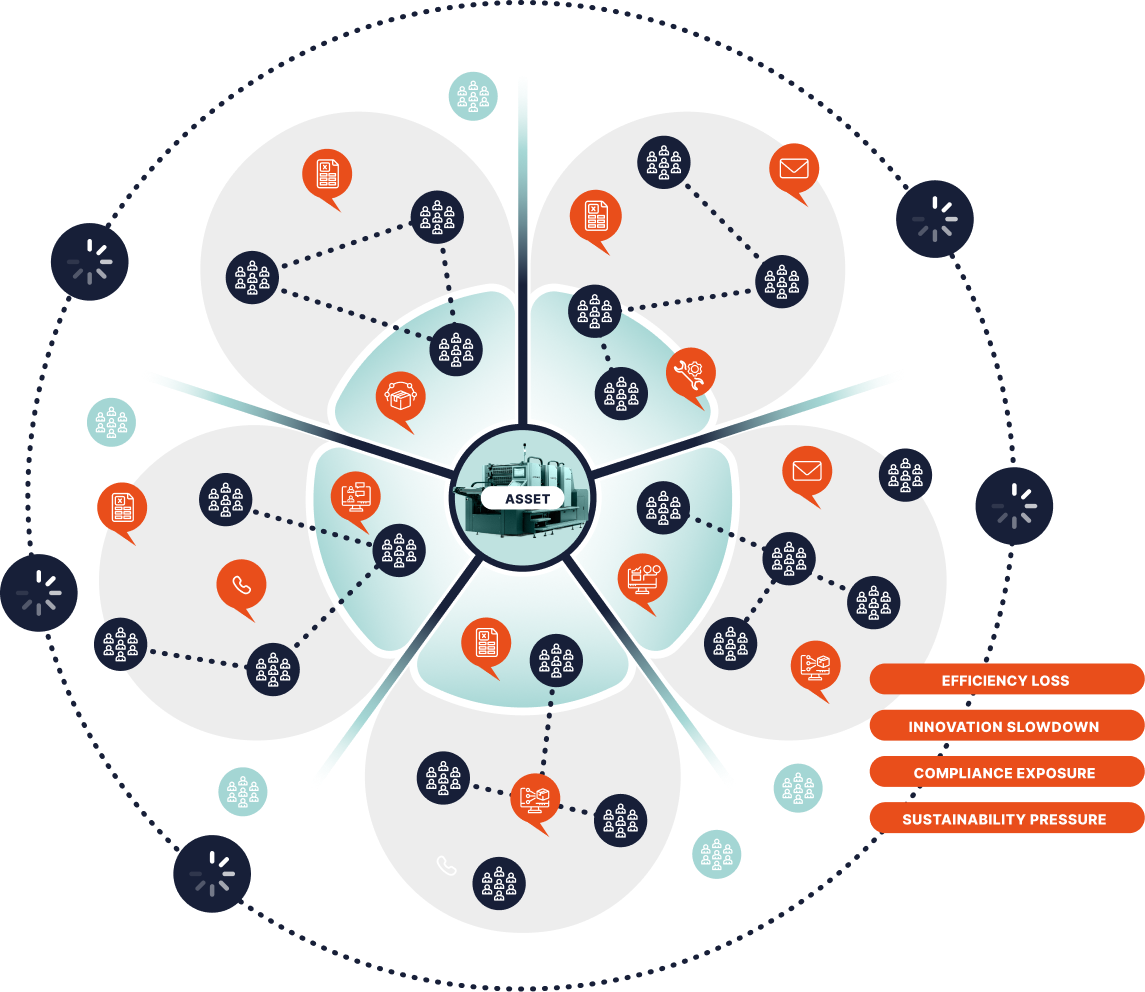
Meanwhile systems keep multiplying. Every team builds its own portal, its own registry, its own way of tracking what it needs. More systems. More silos. Less coherence.
The result: everyone sees a piece of the asset. No one sees the whole. This isn't an IT problem. It's a collaboration problem.


Fragmented Context Is Costly: Four Ways
The costs rarely show up in one place. They hide in daily frustrations that everyone has come to accept as normal. But the total adds up.
Efficiency drains away
People search for information that exists but can't be found. Coordination eats up time that should go to the actual work. Handovers that should take a day take weeks, not from lack of effort, but from lack of shared context.
Innovation stalls before it creates value
The data to work smarter already exists. But without shared context it reaches the wrong people, at the wrong moment, in the wrong format. Good ideas fall apart on execution problems that have nothing to do with the idea itself.
Compliance becomes a manual effort
Regulations demand accountability across the full lifecycle. Reconstructing that after the fact, from scattered systems, emails, and shared folders, costs time, introduces errors, and creates risk. And the bar only keeps rising.
Sustainability stays an intention
Longer use, smarter reuse, better residual value: all of this requires insight into what an asset has been through. Without shared context, that insight is missing. Assets get written off too soon. Circular opportunities disappear.
Four problems. One cause.

What If Context Moved With Them?
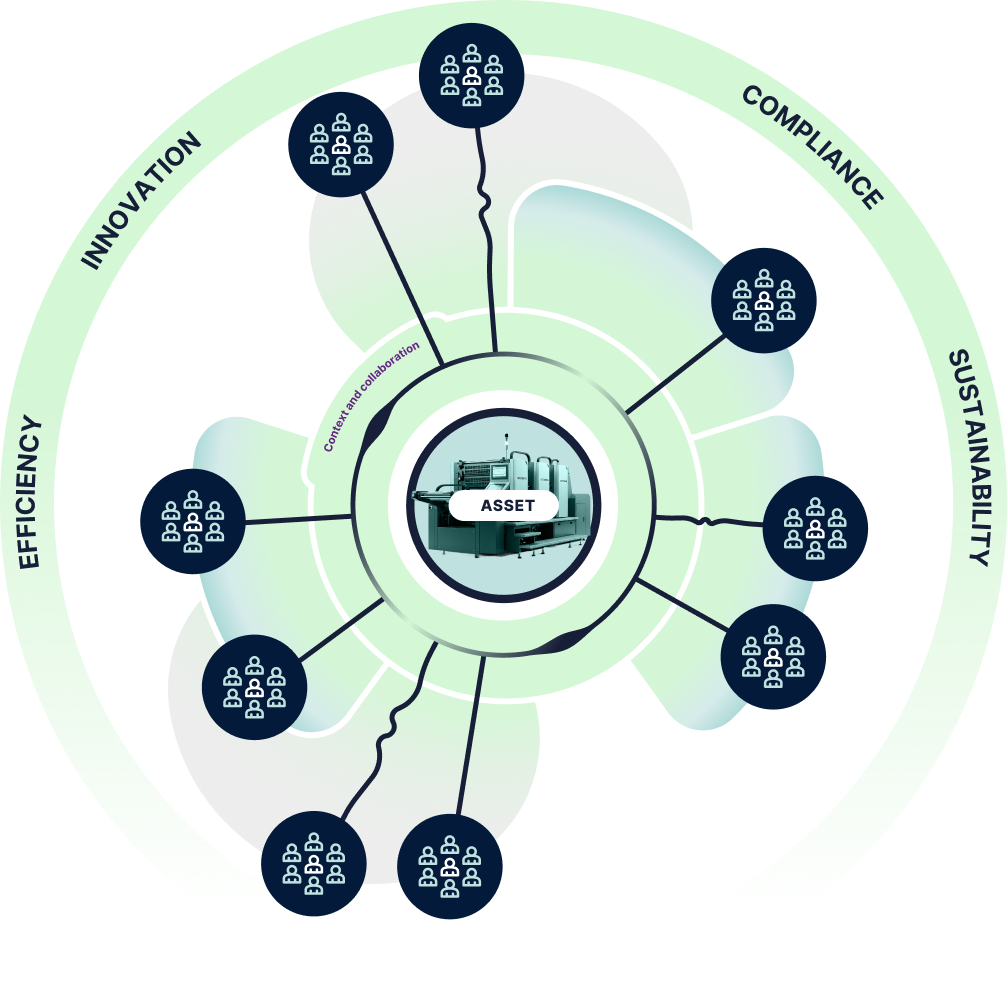
Imagine everyone who works with an asset, engineers, operators, service partners, customers, financiers, working from the same picture. Not the same system. The same picture.
That fundamentally changes how collaboration works.
That's when AI becomes truly valuable
Not as a separate layer on top of fragmented information, but as support that works from the same reliable asset context as the people around it.
When asset context moves with the asset, one shared picture emerges for everyone involved. Teams work more efficiently, innovation gets off the ground, compliance becomes easier to demonstrate, and sustainable choices become actionable.
The value isn't in one system. The value is in the collaboration that becomes possible when everyone works from the same picture.


How Purple Unity Makes That Context Real
Purple Unity makes shared asset context concrete through an open context and collaboration layer around the asset. This layer brings together asset data, companies, contracts, service, support, sharing, and commerce in one workable context.
Purple Unity doesn't replace existing systems. It connects them: ERP, CRM, PLM, asset management, IoT, service platforms, documents, and data environments.
The collaboration layer does six things:
Asset data and context management: one central place for all asset information across the full lifecycle
Company and contacts: all parties connected around the asset
Contracts and agreements: full lifecycle accountability in one clear overview
Asset sharing: enabling use across organizations and business units
Service and support: issues tracked, managed, and resolved efficiently
Commerce and remarketing: unlocking residual value at end of lifecycle
How it works in practice
Internally, the Admin UI offers a powerful environment for management, configuration, and operations. On top of that, organizations build their own digital channels: portals, configurators, apps, and agents.
Via APIs, events, search, authorization, and MCP, information keeps flowing between systems, processes, and users, without losing existing investments.
Organizations can start small with a single use case, improve where value is leaking most, and expand as new portals, services, or collaborations connect to the same shared context. Innovation becomes an extension, not a disruption.


Where Does Value Leak in Your Organization?
Every organization has assets that pass through many hands. Your teams, customers, partners, and suppliers all work on the same assets, though often from different processes, systems, and information sources.
The value scan workshop
In an open workshop, Purple Unity maps your asset lifecycle together. We look at your assets, your stakeholders, your processes, and the information needed to collaborate effectively.
What you get back:
This creates a shared understanding of the current situation and the opportunities to unlock more value from your assets.
Purple Unity connects asset data, processes, systems, and partners into one digital foundation. Work more efficiently, innovate faster, demonstrably meet agreements, legislation, and customer expectations.


Every asset can create more value.
Purple Unity helps organizations unlock that value by making collaboration around assets easier, smarter and scalable across the entire lifecycle.